Walking, Waiting or Riding: Three Ways to Read a City Route
Walking, waiting or riding a city route shows how Đại học Thăng Long and casino-related places meet public streets, helping you choose what to observe.
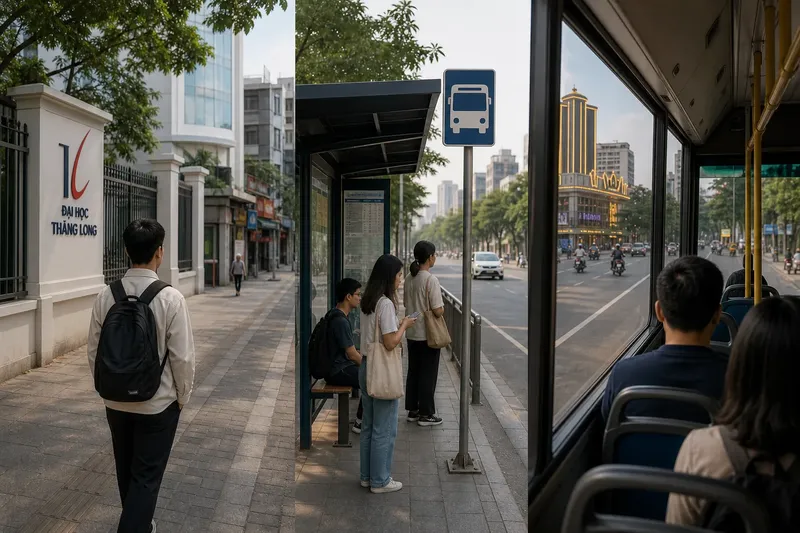
Which parts of a city route can you actually understand from the pavement, a bus stop or a moving vehicle? Walking, waiting or riding a city route changes what you can see around Đại học Thăng Long and casino-related places, without making a visit to either venue the point.
A gate and its pavement show a street edge; a public stop shows how different journeys share space; a ride gives a passing view of the streets between destinations. Each view has limits. Keep the subject to public space, and do not infer where a person is going from where they happen to wait.
Walking shows how the campus meets the street
On foot, the transition between Đại học Thăng Long and its surroundings is easiest to read. You can see whether the pavement continues past the gate, where the entrance meets the road, and which nearby services face the same stretch of street. These are visible details, not a complete account of campus life.
The same approach applies to a casino-related building elsewhere in the city. From an ordinary public pavement, signs, lighting and the shape of an entrance tell you how the building presents itself to passers-by. They do not tell you what happens inside.
Walking is the useful choice when your question concerns street edges, frontage or the sequence of nearby buildings. Stay on public routes. There is no need to approach a private entrance, enter university grounds without permission or photograph people without consent.
Waiting reveals how a public stop is shared
A bus stop or other lawful public waiting place turns a route into a small shared space. You can notice whether people can identify the stop, whether the pavement leaves room to wait, and how the setting relates to nearby streets and entrances.
That view can put campus-bound movement alongside other ordinary journeys, but it cannot identify anyone’s destination or reason for travelling. A casino-related site seen from a public stop is likewise only part of the setting; people waiting nearby may have no connection to it.
Waiting suits questions about public access and the arrangement of a stop. It is less useful for close architectural detail. Keep your attention on signs, shelter, pavement and the surrounding layout rather than following individual passengers.
Riding gives a sequence of places, not a close view
A bus, taxi or other ordinary ride can show how streets and districts follow one another. You might glimpse university roads, commercial corridors, housing and junctions on the same journey. That sequence helps place a campus or casino-related building within a wider city route.
The trade-off is detail. A sign or entrance seen through a vehicle window passes quickly, and the route itself determines what appears. Riding is useful for the broad pattern of a journey, not for deciding what a building is like inside or how people use it.
Choose a route view by what you need to observe
- Check whether the question is about a gate, pavement or frontage; if it is, walk a public stretch, and if it is not, choose the view that fits the subject.
- Check whether the pavement continues past the entrance; if it does, note how the street connects, and if it does not, observe from another lawful public point rather than stepping into a private area.
- Check whether a public stop is clearly identifiable; if it is, use it to observe the setting, and if it is not, move to a suitable public waiting place or leave that question unanswered.
- Check whether the waiting area leaves room for people to pass; if it does, note how waiting and movement share the space, and if it does not, do not linger there.
- Check whether your question concerns the order of streets and districts; if it does, use an ordinary ride, and if it concerns small details, walk a public stretch instead.
- Check whether a building is visible from the route; if it is, describe only its public-facing features, and if it is not, do not make a detour onto private property to obtain a view.
- Check whether your observation would require tracking or photographing strangers; if it would, change the focus to the setting, and if that is not possible, stop observing.
A short route makes the trade-offs concrete
Say you have an invented route-planning question: how does a public street near Đại học Thăng Long differ from a corridor where a casino-related building is visible? Your starting inputs are two places, one question about public-facing streets, and three observation slots—one walk, one wait at a lawful public stop, and one ordinary ride. These are planning quantities for this imagined situation, not reported route facts.
For the walk, take the public stretch by the university gate and record three items: whether the pavement reaches the gate, whether the entrance faces the road, and whether a nearby service opens onto the same stretch. If the pavement connects and the entrance faces the road, the resulting note is “visible street connection”; if either is unclear, record that uncertainty rather than filling it in.
For the wait, use the public stop already on the route and note two items: whether its sign is identifiable and whether people can wait without blocking the pavement. If both are observable, the result is a usable view of the stop’s layout; if either is not, choose a different lawful public stopping point or omit that comparison.
For the ride, follow the planned ordinary route and note the order of the university area, main-road stretches and the street where the other building appears, if it is visible. If the building can be seen, the result is a passing account of its place in the sequence; if it cannot, mark it as not visible from that route. The trade-off is clear: the walk answers the frontage question, the wait answers the shared-space question, and the ride supplies context without promising a close view.
Which route view answers your question?
What can walking show that riding cannot?
Walking gives you time to inspect public details such as pavement continuity, entrances and nearby services. A moving vehicle may show their general position but not enough detail to describe them reliably.
Is waiting useful if I am not travelling to the venue?
Yes, if you use a lawful public waiting place and observe its layout rather than individual passengers. It can show how a stop fits into the street, but not why anyone is there.
Can a street view tell me what a casino is like inside?
No. A public view can show features such as signs and entrances, but it cannot establish what happens indoors. Keep any description to what is visible from the street.
How should I choose among walking, waiting and riding?
Walk to look at street edges, wait to consider how a public stop is shared, and ride to understand the order of places along a route. If none fits without intruding on others or entering private space, leave the question open.
Keep the observation narrower than the place
The most useful account of a city route is often modest: a pavement connects to a gate, a stop occupies a particular part of the street, or a ride passes several kinds of neighbourhood. For a walking, waiting or riding city route around Đại học Thăng Long and casino-related places, those observations can explain the public setting without pretending to explain the whole institution. A special detour to collect a view is not worth the effort when the route already answers the question you set.