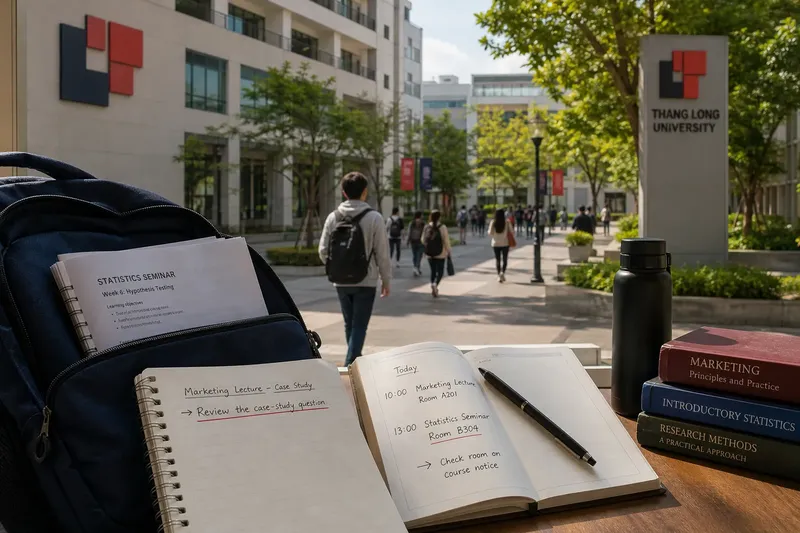
How Shared Campus Spaces Shape Student Life at Đại học Thăng Long
Shared campus spaces at Đại học Thăng Long shape how students pause, study and talk; learn to read the room and choose a place that fits your task.

How do shared campus spaces at Đại học Thăng Long affect the day between classes? They shape where students pause, work, talk and cross paths, often through small decisions about noise, access and how long a task needs.
A seat near a corridor can make a short wait feel convenient, while the same traffic can interrupt reading or a conversation. Shared spaces are not merely spare rooms between scheduled activities: their layout and everyday use influence how students organise time, meet one another and move through campus.
Shared spaces give the day a flexible middle
Timetables divide a day into classes, but student life also happens in the intervals around them. A common area can hold a quick conversation, a pause before the next class or the practical business of sorting notes. That flexibility matters because not every task needs a booked room or a long stretch of concentration.
The space also shapes what is easy to do. A small table near a busy route may suit checking a timetable or arranging a folder. It may be a poor fit for spreading out books or discussing a group assignment. Students adapt their plans to the room, and sometimes adapt the task instead: reading a short section now, saving a longer discussion for somewhere less exposed to passing traffic.
Layout affects who can join in
Clear routes and usable furniture are not just matters of neatness. They affect whether people can reach a seat, join a group or pass through without asking others to move. Bags left in a doorway or chairs pulled across a corridor can turn a shared area into an obstacle course with no obvious finish line.
When choosing a place, look at the route to the seat and nearby facilities, as well as the furniture itself. A chair that appears unstable is a reason to choose another one and report the problem through the usual campus channel. A table with a clear surface gives a group room to work; a blocked route gives everyone else a reason to work around them.
Room activity changes the kind of student life it supports
A room’s label does not tell you exactly how it is being used at a particular moment. A study area may have quiet readers in one part and people passing through another. The current mix of voices, movement and available surfaces affects whether the space suits close reading, casual conversation or a short wait.
Those conditions can shape social contact, too. A common area makes brief encounters and informal conversation easier; a quieter corner gives people a chance to focus without turning every pause into a meeting. Neither use is inherently better. The useful question is whether the room’s current activity fits what you and the people around you are trying to do.
- Check whether voices carry to your seat; if they interrupt close reading, then move to a quieter area, or switch to a task that tolerates background conversation.
- Check whether people are passing through your work area; if their route is crowded, then choose another seat, or keep your visit brief and leave the route clear.
- Check whether the table has room for the materials you brought; if it does not, then put away what you do not need, or find a larger surface.
- Check whether bags or chairs narrow a path; if they do, then move your own belongings, or choose a seat that does not obstruct the route.
- Check whether furniture appears stable and intact; if it does not, then avoid that seat, or use another and report the issue to campus staff.
- Check whether nearby people are reading quietly or talking; if your group discussion would intrude, then move to a common area, or keep the exchange brief.
What is not worth the effort is trying to assign a permanent character to a room from one visit. A burst of conversation tells you what is happening now, not what the space must be like all day.
Small choices make shared use feel fairer
Shared facilities influence how welcome and workable a space feels. Signs help visitors find their way; bins and noticeboards support ordinary use; furniture placement affects whether people can pass or gather. When something is missing, unclear or obstructed, students may have to spend time working around it instead of using the space for its intended purpose.
There is a social side to these choices. Putting rubbish in the appropriate bin, leaving posted information visible and keeping belongings out of routes help the next person use the room without negotiating around someone else’s improvised arrangement. If a sign is obscured or a facility is unusable, report it to the relevant campus contact rather than rearranging the space in a way that creates another problem.
Choose a space by the task and its effect on others
Say you have a notebook and a folder, and the nearest table is beside a route between the entrance and the seats. You notice that a pulled-out chair narrows the path. If it is clearly movable and can be returned without blocking anyone, you move it back; otherwise, you choose another table. At that seat, both items fit, but conversation carries from a nearby group. You organise your notes there, then move to a common area when your task changes to discussion. The choice lets you use the space without treating a shared room as if it belonged to one person.
These small adjustments influence the rhythm of campus life. Students can use short gaps productively, meet without arranging a formal room and leave space for others to do the same. The result is not that every corner serves every purpose; it is that people can match their activity to the conditions in front of them.
What do students need to know about shared campus spaces?
How do I choose between a quiet area and a common room?
Match the space to the task: choose a quieter area for close reading, and a common room for conversation when its current use allows it. If the room’s activity changes, move or switch tasks rather than expecting everyone else to adjust.
What should I do if a seat or route is obstructed?
Choose a different seat if bags, chairs or furniture make the route difficult to use. Move only your own belongings, or an item that is clearly movable and can be left safely out of the way; report persistent problems to campus staff.
Can a shared space help with group work?
It can, if the room’s current activity and layout suit conversation without blocking routes or disturbing people who are working quietly. If discussion would intrude, find a more suitable common area or save the conversation for later.
Why do small shared-space habits matter?
Keeping routes clear, using bins and leaving signs visible reduce avoidable friction for people arriving after you. The room remains easier to use when each visitor treats it as shared rather than temporarily private.
Leave the room ready for another use
Before leaving, take your belongings, dispose of rubbish properly and return movable furniture to its intended position. Report persistent problems such as damaged furniture or an obstructed sign through the usual campus channel. These habits keep the space available for a different student with a different task.
Shared campus spaces at Đại học Thăng Long shape student life through repeated, ordinary encounters: a place to pause, a table for notes, a route kept open and a room used for talk. Reading those conditions helps you choose well, while leaving room for the next person to make a different choice.