From Private Rooms to Public Image: The Casino in City Stories
See how the casino became a public image in city stories, and read its changing role without mistaking a familiar symbol for the whole city.
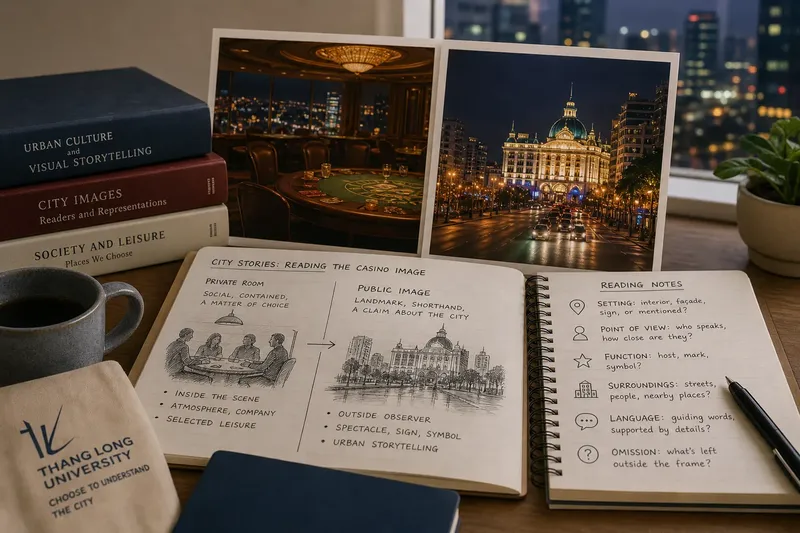
What does a casino mean once it has become a familiar image of the city? In city stories, the casino’s public image often begins with a private room: a place associated with leisure, risk and chosen company, then recast as a landmark, a shorthand or a scene-setter.
These are field notes on that change in representation, not a history of venues. A student reading a city-facing story alongside university life at Thăng Long University can ask a useful question: who gets to describe the casino, and what does the description leave outside the frame?
The private room becomes a public shorthand
In private-room imagery, the casino belongs to a bounded social world. A door, a table or a cluster of companions suggests that the scene is meant for those inside it. The emphasis falls on choice and atmosphere: someone has entered a particular setting for a particular kind of leisure.
City storytelling changes the scale. A casino may become a named point in a skyline, a bright façade in a film sequence or a recognisable sign in a visitor’s account. The scene now asks readers to understand something about the city, even when the casino itself is only in the background.
That shift is efficient. One image can signal nightlife, spectacle or the promise of escape without a paragraph of explanation. It is also blunt. A shorthand makes a place legible by narrowing it, and the city can disappear behind the symbol used to represent it.
- Notice the camera’s distance. A close view of a table makes the casino feel social and contained. A wide view that includes surrounding streets makes it part of a larger urban composition.
- Notice who names the place. A character’s account may reflect personal preference; a narrator’s label can turn the same setting into a judgement about the city.
- Notice what the image asks you to infer. If a sign is shown but no one speaks, the casino may function as atmosphere rather than as a place the story intends to examine.
Public image depends on the storyteller
A casino’s public image is not a single meaning attached permanently to a building. It is assembled by the person telling the story, the audience being addressed and the details selected for attention. A travel account, a campus conversation and a film scene can use the same familiar setting to make different points.
For a visitor, the casino might stand for a night out or an unfamiliar city’s leisure landscape. For a student, it could appear in a class discussion about popular culture, in a conversation among friends or simply as a recognisable feature of a city story. None of those readings automatically describes how the venue operates or what every visitor experiences.
The distinction matters around a university. Student life generates its own public stories: a route remembered for a landmark, a neighbourhood described through a particular scene, or a film reference passed between classmates. Those accounts can make a city seem close at hand, but they are still partial. They tell us how someone has framed the city, not what the city must mean to everyone in it.
Ask whether the storyteller is speaking from inside the scene or observing it from outside. An insider may focus on habit, conversation or social belonging. An outside observer may foreground spectacle, unfamiliarity or moral judgement. Each can reveal something; neither should be mistaken for the view from nowhere, a position rarely occupied except by a camera crane.
What does the casino image leave out?
Why does a casino become a city symbol?
A casino can be visually distinctive and easy to recognise, which makes it useful in a compact story about place. The symbol may communicate nightlife or spectacle quickly, but it cannot stand in for every part of urban life.
Does a familiar image describe the venue itself?
Not necessarily. A film or travel account may use the casino for mood while offering little information about the people, rules or activities within it.
How can a student read a casino scene critically?
Separate what the scene shows from what it implies. Note who is present, whose point of view controls the description and which parts of the surrounding city remain unseen.
Can one city have several casino images?
Yes. The venue may appear as a leisure setting, a landmark or a symbol of urban change, depending on the storyteller’s purpose. Those images can sit beside one another without any single one becoming the definitive account.
Read the framing before accepting the symbol
A small comparison can make the shift visible. Imagine a student at Thăng Long University reading two short city descriptions for a seminar. In the first, the casino appears as a private room where a group meets for an evening; in the second, its illuminated exterior is used to suggest a city’s public character. The student marks the first as a social scene and the second as a claim about place, then asks which voices and surroundings each description omits. The expected result is not a verdict on the casino, but a clearer distinction between a setting and a public image.
That distinction is useful when a story moves quickly. A location can carry emotional weight without receiving much direct description. If the casino is introduced as glamorous, threatening or ordinary, look for the details that earn the label. Is it the architecture, the behaviour of a character, the narrator’s vocabulary, or merely the fact that the sign is visible?
It can also help to separate an image’s reach from its accuracy. A familiar symbol may circulate widely because it is easy to recognise, not because it offers a complete portrait. When a story uses a casino to represent the city, ask what else could have served that role and why this image was chosen.
Use a small set of reading notes
For a compact field note, record the scene rather than trying to settle its meaning at once. These prompts suit a film, a short story, a travel account or a conversation about urban imagery:
- Setting: Is the casino shown as an interior, a façade, a sign or a place mentioned in passing?
- Point of view: Who describes it, and how close are they to the people in the scene?
- Function: Does it host an event, mark a location or stand for a broader idea about the city?
- Surroundings: Which streets, people or neighbouring places appear alongside it?
- Language: Which words guide the reader’s judgement, and are those words supported by visible details?
- Omission: What would a different storyteller need to include to complicate the image?
These notes work best as questions, not as a scoring system. A story can be selective without being careless; selection is part of storytelling. The point is to see where the framing begins, rather than to demand that every scene explain an entire city.
Keep the symbol in proportion
Public images are useful because they make a place memorable. Their limitation is the same quality: they compress. A casino may help a story suggest private leisure, public spectacle or a city’s imagined character, while saying very little about the varied lives around it.
For readers connecting city stories with student life at Thăng Long University, that gap is not a problem to solve by borrowing another ready-made image. It is a reason to ask how the account was made. The most revealing question is often not whether the casino represents the city, but who benefits from that representation and what the reader can see once the frame widens.
When a casino appears in a city story, treat it as evidence of the storyteller’s choices first and as evidence about the city only with care. That modest distinction makes the public image easier to read—and leaves room for the city to be more than its best-known backdrop.