How Campus and Casino Scenes Use Space to Shape a Story
Compare campus and casino scenes by tracing routes, boundaries and pauses, and see how a room shapes a character’s choices without standing for a real place.
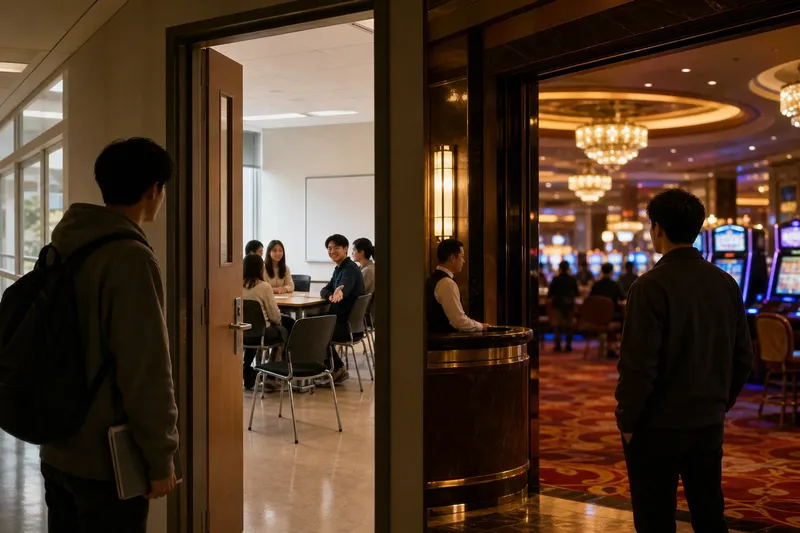
What does a room make possible for the people in it? To compare campus and casino scenes, trace the routes characters take, the boundaries they meet and the choices the story gives them. A seminar room at Đại học Thăng Long and a fictional casino floor need not explain one another.
Start with the character’s route
Choose a short scene from a film, episode, novel or play. Record the character’s starting place, destination and any point where movement stops or changes direction. In a film, pause when the route is clear; in prose, note which parts the narrator leaves unspecified.
This gives you a small, usable account of the scene: someone enters, waits, crosses a room or turns back. Only then ask what that movement does for the story. A route can create delay, bring two characters together or keep someone at a distance without making a claim about how a real institution operates.
It is not worth the effort to assign a hidden meaning to every chair or light fitting. If an object does not affect movement or receive sustained attention, let it remain furniture.
Compare boundaries and choices
A campus scene may place a character between a corridor and a seminar room, or between a group and an unoccupied seat. A casino scene may keep someone near an entrance, a counter or a route into a larger area. The useful comparison is not that these places are alike; it is how each scene allows or delays a character’s next move.
Separate visible action from inferred rules. If a character is stopped at a door, record who stops them and what happens next. If nobody tries to cross a boundary, do not decide that the boundary is enforced. A closed door is evidence of a closed door, which is already enough to describe.
Follow attention across the room
Instead of treating sightlines as a general mood, track what a character can act on. Can they see the person they want to approach? Does another character block the route? Does the camera stay with someone who waits while others move on?
In prose, distinguish the character’s knowledge from the narrator’s. In film or television, distinguish what the camera shows from what anyone in the scene notices. This helps explain how space organises information: a character may hesitate because a destination is unclear, or the audience may know something the character cannot see.
Use emotional labels sparingly. “The character remains beside the doorway while the group continues talking” is more useful than calling the room intimidating without pointing to an action that supports the description.
What does the scene let a character do?
How should I compare a campus room with a casino setting?
Compare a specific action, such as entering, waiting or choosing a seat, rather than treating the locations as equivalent. Then explain what each scene makes possible for its character.
What does a character waiting at a doorway suggest?
It shows a pause at a boundary, but the reason may remain unclear. Note whether another person responds, whether the character moves on and whether the story supplies an explanation.
How do I tell a character’s view from the audience’s view?
Ask what the character can see or hear at that moment, then compare it with what the camera or narrator gives the audience. A difference between the two can create suspense or irony without proving that anyone feels watched.
Can a fictional scene describe Đại học Thăng Long or a real casino?
Not by itself. A story may borrow a name or familiar visual detail, but its arrangement remains a choice made for that work unless supported by separate, reliable information.
Use a short record to keep the comparison grounded
For each scene, note an observation and decide what it supports. If the detail is missing or ambiguous, choose a narrower description rather than filling the gap with an assumption.
- Starting point: Check where the character begins. If the scene identifies a place, record it; if not, describe the visible position without naming a room.
- Destination: Check whether the character has a stated destination. If one is named, record it; if the character’s aim is unclear, leave the purpose open.
- Boundary: Check for a door, counter or other division. If someone acts to stop or admit the character, describe that action; if nobody does, do not infer an entry rule.
- Route: Check where the character walks and where they stop. If the route reaches a visible destination, record the sequence; if it disappears from view, mark the route as incomplete.
- Choice: Check what the character does after a pause or obstacle. If they change direction, note the change; if they remain still, do not invent a reason.
- Response: Check whether another character notices or answers. If someone responds, record the response; if nobody does, describe the silence without deciding what it means.
- Point of view: Check what the character can perceive against what the camera or narrator reveals. If the audience receives extra information, note the difference; if both views match, keep the account simple.
Say you are comparing two invented scenes. In the campus scene, a student starts in a corridor, walks to a seminar-room door, sees classmates around a table and takes an open chair after one classmate gestures. Record the corridor as the starting point, the chair as the destination, the door as a boundary crossed and the gesture as a response. In the casino scene, a visitor starts beside a staffed entrance, looks towards a bright central area and stays where they are. Record the entrance as the starting point, the central area as a direction of attention rather than a confirmed destination, and the visitor’s continued pause as the final action. The comparison supports a limited answer: one character enters a group after an invitation, while the other does not proceed beyond the entrance. It does not establish how welcoming either real place is.
Keep real places separate from fictional choices
A scene set at or inspired by Đại học Thăng Long does not account for the varied routines of students and staff. A casino scene may focus on spectacle, work, chance or one visitor’s experience while leaving other routines outside the story.
Keep the claim close to what the work shows: a character’s route, the boundary they encounter and the choice that follows. That is enough to explain how campus and casino scenes use space to shape a story, without turning a designed setting into evidence about a real place.